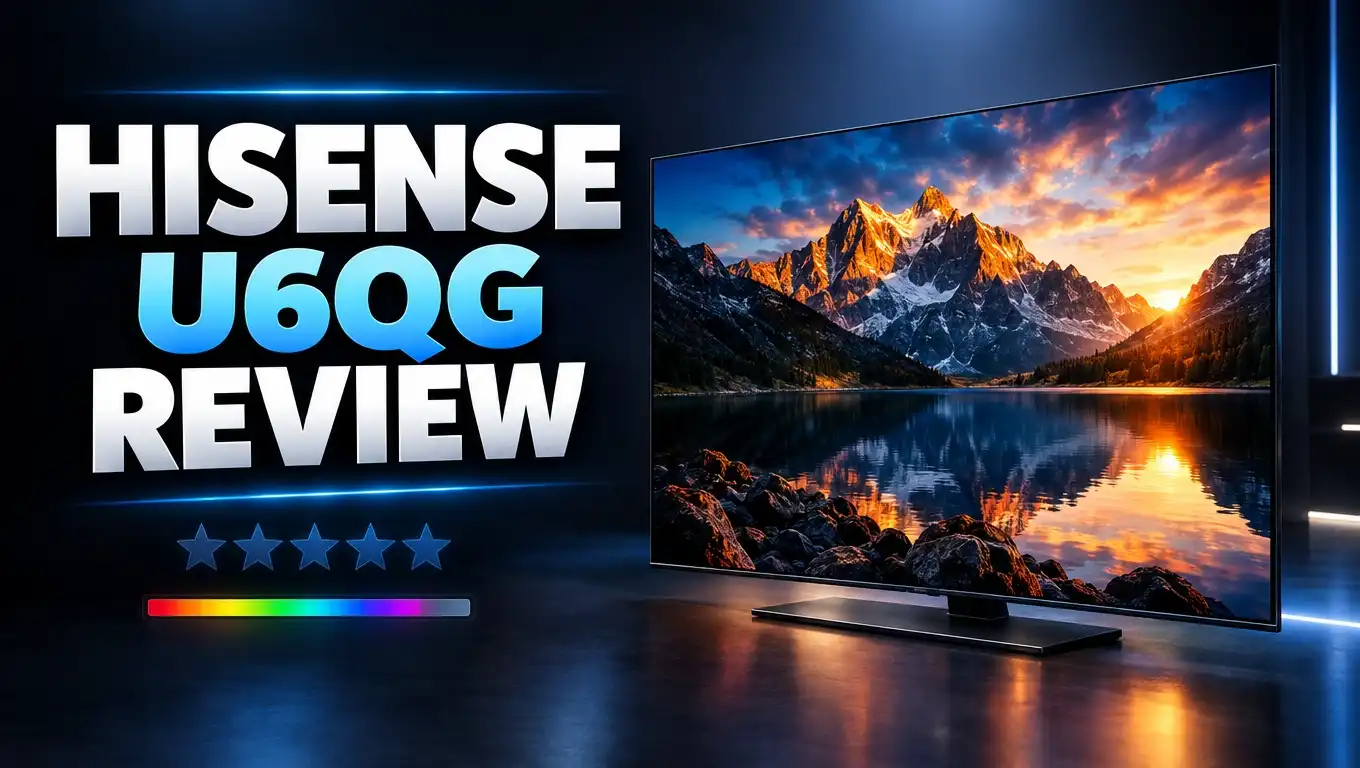
Hisense U6QG Review: Budget Mini LED TV Worth It in 2026?
Want a big, bright 4K TV that doesn’t drain your savings? The Hisense U6QG keeps showing up on deal pages and “best budget TV” lists. It promises Mini LED backlighting, 144Hz gaming, and full HDR support at a very low price.
But can a TV this cheap deliver a good picture? I looked through lab tests, expert reviews, and real owner feedback to find out. Read on to see where the U6QG shines, where it falls short, and whether it belongs in your living room.
In a Nutshell
- Bright picture for the price: Lab tests measured close to 970 nits in HDR, which beats many TVs that cost more. Bright rooms are not a problem for this set.
- Real Mini LED with local dimming: The 65 inch model uses up to 600 dimming zones, which gives you deeper blacks than a regular LED TV. You will still see some blooming around bright objects.
- Gaming ready: The TV runs at a native 144Hz and has two HDMI 2.1 ports, VRR, ALLM, and AMD FreeSync Premium. Input lag sits around 13 milliseconds.
- Every HDR format: It supports Dolby Vision, HDR10+, HDR10, and HLG, so all your streaming content looks the way it should.
- Basic sound and smart system quirks: The 2.1 channel, 40W speakers work fine for TV shows. Movie fans should add a soundbar.
- Great value: Sale prices have dropped to around $529 for 55 inches and roughly $550 for 75 inches during big sales.
Hisense U6QG Mini LED TV Overview

- MINI-LED WITH UP TO 1000 NITS PEAK BRIGHTNESS AND UP TO 600 LOCAL DIMMING ZONES: See more contrast on the field and off. Lots of tiny...
- HI-VIEW AI ENGINE: Feel like you’re in the stands even when you’re watching from your couch. Controlled by a high-powered AI...
Last update on 2026-10-17 / Affiliate links / Images from Amazon Product Advertising API
The Hisense U6QG is the entry model in Hisense’s 2025 ULED Mini LED lineup. It sits below the U7, U8, and U9 series. Its job is simple: bring Mini LED picture quality to people on a tight budget.
A quick note on the name. Hisense first announced the series as the U6QG. In the US, the matching model numbers end in U65QF, and these run Fire TV. In Canada, the Google TV version sells as the U68QG. The panel and core features are the same.
The TV comes in many sizes. You can pick 55, 65, 75, 85, or even 100 inches, so it suits small apartments and big home theaters alike. That huge size range is rare at this price.
Inside, the TV uses Quantum Dot color (Hisense calls it QLED) on top of the Mini LED backlight. The Hisense AI Engine processor handles upscaling, contrast, and motion. It adjusts the picture to the content in real time.
Expert sites love this TV. PCMag called it “easily the brightest and most colorful budget friendly TV” it had tested. Reviewed.com also named it a great pick for budget shoppers and noted it is slightly brighter than its main TCL rival.
In short, the U6QG gives you midrange features at an entry level price. Let’s look at the details.
Key Specs of the Hisense U6QG
Before we judge the picture, let’s look at what you get on paper. These specs come from Hisense and retailer listings for the 2025 U6 series. Some numbers change slightly by screen size.
The TV has a 4K UHD resolution of 3840 x 2160 pixels. It uses a native 144Hz panel with a Motion Rate of 480. Peak brightness reaches up to 1,000 nits, and the 65 inch model has up to 600 local dimming zones.
For HDR, you get Dolby Vision, Dolby Vision IQ, HDR10+, HDR10+ Adaptive, HDR10, and HLG. Gamers also get Dolby Vision Gaming and HDR10+ Gaming. Very few budget TVs support this many formats.
Connections are solid too. There are four HDMI ports: two HDMI 2.1 and two HDMI 2.0. HDMI 1 supports eARC for soundbars. You also get USB ports, Ethernet, optical audio, and an antenna input with an ATSC 3.0 tuner in the US model.
Wireless options include WiFi 6 (WiFi 6E on the Canadian Google TV model) and Bluetooth 5.2. You can pair headphones or a wireless speaker easily.
The audio system is a 2.1 channel setup with 40W of power and a built in subwoofer. It decodes Dolby Atmos. The 65 inch model weighs about 42 pounds and uses a 400 x 400 VESA wall mount. Hisense backs US models with a two year warranty, which beats the one year many rivals offer.
Design and Build Quality
The Hisense U6QG looks clean and modern. The bezels are thin on three sides, so the picture fills most of the front. It does not look like a cheap TV when it is turned off.
The 65 inch model measures about 3 inches deep. That is a little thicker than the TCL QM6K, which is 2.2 inches deep. From the front, you will not notice the difference.
The TV stands on two V shaped feet. They are easy to attach, but they sit near the edges of the TV. You need a wide stand or table to hold the larger sizes. Some sizes let you mount the feet in two positions, so check your furniture before you buy.
Wall mounting is simple. The 65 inch model uses a 400 x 400 VESA pattern, which fits most common mounts. It weighs about 42 pounds without the stand.
The remote deserves praise. Hisense includes a backlit voice remote with a sleek silver finish. Tom’s Guide said it preferred the Hisense remote over TCL’s smaller black remote. The backlight helps a lot during movie nights in a dark room.
Build quality feels solid for the price. The back panel is plastic, which is normal at this level. Nothing feels flimsy, and the ports are easy to reach from the side.
Top 3 Alternative for Hisense U6QG
The U6QG is a great value, but it is not your only choice. Here are three strong options for different needs and budgets.

- TCL QM6K QD-MINI LED TV SERIES - AFFORDABLE PREMIUM PERFORMANCE FOR SPORTS, GAMING & STREAMING. Experience superior contrast, rich...
- QD-MINI LED. IT’S MINI LED PLUS QLED COLOR - BREATHTAKING BRIGHTNESS AND COLOR IN ANY LIGHT. Combines ultra-precise Mini LEDs with...

Last update on 2026-10-17 / Affiliate links / Images from Amazon Product Advertising API
The TCL QM6K is the U6QG’s closest rival. It runs Google TV and has a 144Hz panel, Mini LED backlighting, and every HDR format. It is a little thinner and has a matte, glare reducing screen.
The QM6K is not as bright as the Hisense. Lab tests measured about 695 nits in HDR, compared to 968 for the Hisense. It is still a good pick if you want Google TV and a slimmer design.

- Mini-LED Pro With Up to 3000 Local Dimming Zones And Up to 3000 nits Peak Brightness: See the realism of every shadow cast by the...
- Native 165Hz Panel With Game Booster 288: Turbo power your gaming! The Native 165Hz Panel has a Variable Refresh Rate of 48Hz to 165Hz...
Last update on 2026-10-17 / Affiliate links / Images from Amazon Product Advertising API
The Hisense U7 (U75QG) is the step up. It reaches up to 3,000 nits of brightness and uses many more dimming zones. It also has a 165Hz panel and Google TV.
Reddit owners call the jump from U6 to U7 “huge” in picture quality. If you can stretch your budget by a few hundred dollars, the U7 gives you much less blooming and stronger HDR.

- QD-Mini LED: TCL's QD-Mini LED combines the merits of QLED and OLED technologies, transforming the traditional backlight into lighting...
- TCL Halo Control System: An advanced Technology Suite that includes the New Super High Energy LED Microchip, Super Condensed Micro...
Last update on 2026-10-17 / Affiliate links / Images from Amazon Product Advertising API
The TCL QM7K competes with the Hisense U7. It offers up to 3,000 nits, an antireflective screen, and Bang & Olufsen audio. It is a great choice for bright rooms and gamers who want a 288Hz game mode.
Picture Quality and Brightness
Picture quality is where the Hisense U6QG really impresses. The TV is very bright for a budget set. Colors look rich and full, and the image has a nice punch.
Tom’s Guide ran lab tests on the 65 inch model. It measured 653 nits in SDR and 968 nits in HDR on a 10% window. The TCL QM6K reached only 265 nits in SDR in the same test. That is a massive gap for everyday TV watching.
Why does SDR brightness matter? Most cable shows, sports, and YouTube videos are SDR. A bright SDR picture helps you see clearly in a sunny living room. The U6QG handles daytime viewing with ease.
Color accuracy is also strong. The TV scored a Delta E of 1.8 out of the box in testing. Lower is better, and anything under 3 looks accurate to most eyes. It covered about 95.65% of the DCI P3 color space, which means vivid, lifelike colors.
The AI 4K upscaler does a decent job with lower resolution content. Older shows and HD broadcasts look clean and sharp. Very low quality sources can still look soft, which is normal for any TV.
There are a few weak spots. Viewing angles are narrow because the TV uses a VA style panel. Colors and contrast fade if you sit far to the side. Sit near the center for the best picture.
HDR Performance
HDR content makes the U6QG look like a much pricier TV. The Total HDR Solution means it plays every major format. Netflix, Disney+, Prime Video, and Apple TV+ content will all look the way the creators planned.
Dolby Vision support is a big win. Many Samsung TVs skip it entirely. With the U6QG, you get dynamic HDR that adjusts brightness scene by scene. Dolby Vision IQ goes further and uses a light sensor to tune the picture to your room.
HDR10+ support is also included. This matters for Prime Video and some 4K Blu ray discs. Having both Dolby Vision and HDR10+ means you never miss out.
Highlights really pop on this TV. Sunlight, explosions, and city lights at night shine brightly. Even in Filmmaker Mode, the TV hit about 946 nits in testing, compared to 559 nits on the TCL QM6K.
Hisense also adds an AI HDR Upscaler. It boosts regular HDR10 content closer to HDR10+ quality. It can also give SDR content an HDR like look. Some viewers love this. Purists may want to turn it off.
The TV is not perfect here. Bright highlights can cause blooming in dark scenes, which is a soft glow around bright objects. This is common on budget Mini LED TVs. The effect is mild in most movies, but you may notice it with subtitles on a black background.
Local Dimming and Contrast
Local dimming is the key reason to buy a Mini LED TV. The backlight is split into many zones. Each zone can dim or brighten on its own. This creates deeper blacks and better contrast than regular LED TVs.
The 65 inch U6QG uses up to 600 dimming zones, based on Best Buy’s listing. The Canadian Google TV version lists 300 zones for its 65 inch size. Zone counts vary by size and region, so check the exact model you buy.
In real use, black levels look very good. Dark movie scenes show deep shadows instead of gray haze. One owner on Reddit said the blacks are “really good for non OLED.” Space scenes and night shots look clean.
Fewer zones does mean some trade offs. Blooming shows up around bright text or small light sources on dark backgrounds. A Reddit commenter noted that the 6 series has fewer zones than the 7 series, so blooming is slightly more noticeable.
You can control the dimming strength in the picture settings. RTINGS suggests setting Local Dimming to High for HDR content. A lower setting reduces blooming but makes blacks look less deep. Try both and pick what you like.
Screen uniformity is decent for the price. Most panels show only small differences in brightness across the screen. Panel quality can vary between units, so check your TV carefully in the first few weeks.
Gaming Performance
Gamers get a lot from the Hisense U6QG. The native 144Hz panel gives smooth motion with PC games and supported console titles. Most budget TVs top out at 60Hz, so this is a big upgrade.
There are two HDMI 2.1 ports. These support 4K at 144Hz, which fully covers the PS5 and Xbox Series X. You get variable refresh rate (VRR) from 48Hz to 144Hz, which stops screen tearing.
The TV also supports AMD FreeSync Premium. This works great with gaming PCs and the Xbox. Auto Low Latency Mode (ALLM) switches the TV to Game Mode automatically when you start a game.
Input lag is very low. Tom’s Guide measured about 13.2 milliseconds. That is fast enough for shooters, fighting games, and racing games. You will not feel any delay during play.
Hisense includes Game Mode Pro and an enhanced Game Bar. The Game Bar shows your frame rate, HDR status, and VRR status on screen. You can also tweak settings without leaving your game.
HDR gaming is a highlight. The TV supports Dolby Vision Gaming and HDR10+ Gaming. Xbox games in Dolby Vision look bright and colorful.
One small catch: only two of the four HDMI ports are HDMI 2.1. If you own a PS5, an Xbox, and a soundbar, plan your connections carefully. HDMI 1 handles eARC, so you may need to use it for your soundbar.
Smart TV Platform
The smart platform depends on where you buy the TV. In the US, the U6 series runs Fire TV. In Canada, the U68QG version runs Google TV. Both give you all the major streaming apps.
Fire TV includes Alexa built in. You can search for shows, control smart home devices, and check the weather with your voice. The US model is one of the few 2025 TVs with Alexa Plus access, which adds smarter voice features.
Fire TV also gives you free live channels and cloud gaming services. You can stream Xbox Game Pass, GeForce Now, and Amazon Luna without a console. That is a nice bonus for casual gamers.
Not everyone loves Fire TV. Some Reddit users complain about ads on the home screen and a Prime Video focus. Others simply prefer Google TV’s layout and search. This is mostly a personal choice.
The Google TV version offers Google Assistant, Chromecast, and strong recommendations across apps. It also works with Apple HomeKit and AirPlay, plus Alexa. If you live in Canada, you get this version.
If you dislike the built in system, there is an easy fix. Plug in a streaming stick like a Google TV Streamer or Apple TV. One Reddit user did just that and said he was happy. It costs very little and solves the problem.
Sound Quality
The Hisense U6QG uses a 2.1 channel speaker system with 40W of total power. It includes a built in subwoofer for a little extra bass. This setup is normal for TVs in this price range.
The speakers support Dolby Atmos decoding. Do not expect true overhead sound, though. The TV has no up firing speakers. Atmos here adds a slightly wider sound field, nothing more.
For daily use, the sound is fine. News, talk shows, and sitcoms sound clear. Hisense adds an AI Clear Voice feature that boosts dialogue and reduces background noise. This helps a lot with quiet speech in movies.
There is also an AI Sports Mode. It makes crowd noise and commentator voices stronger. Sports fans may enjoy the stadium feel.
Big action movies are a different story. Explosions and deep music lack real punch. At high volume, the sound can get thin. Tom’s Guide said not to expect “wall thumping sound” from either the Hisense or the TCL.
The good news is that adding a soundbar is easy. HDMI 1 supports eARC, which passes full Dolby Atmos and lossless audio. You can also use Bluetooth or optical output. Even a budget soundbar makes a big difference.
Larger sizes like 85 and 100 inches may come with slightly stronger speakers. Check the specs for your size if sound matters to you.
Connectivity and Ports
The U6QG offers plenty of connections for a budget TV. You get four HDMI ports in total. Two are HDMI 2.1 for 4K at 144Hz gaming, and two are HDMI 2.0 for cable boxes and streaming sticks.
HDMI 1 supports eARC and CEC. This lets your TV remote control your soundbar’s volume. It also sends high quality audio formats like Dolby TrueHD and DTS.
For wired internet, there is an Ethernet port. Experts suggest a wired connection for the most stable 4K streaming. Cloud gaming works much better over Ethernet.
Wireless performance is strong. The US model supports WiFi 6, while the Canadian Google TV model lists WiFi 6E. The TCL QM6K only has WiFi 5, so the Hisense wins here. You also get Bluetooth 5.2 for headphones and speakers.
The US model includes an ATSC 3.0 tuner, also called NextGen TV. This lets you receive newer over the air broadcasts with an antenna. Some stations now broadcast in 4K HDR this way. The TCL QM6K does not have this tuner.
Other ports include two USB ports, an optical audio output, a headphone jack, and a composite video input. You can play your own videos and photos from a USB drive.
The ports sit on the side of the back panel. This makes it easy to plug in devices, even when the TV is wall mounted.
Price and Value
Value is the biggest reason to buy the Hisense U6QG. Its launch prices were already fair. Sale prices make it one of the best deals in TVs right now.
During Memorial Day 2025, the 55 inch model dropped from $799 to $529. The 65 inch model has sold for around $547 at Amazon. One Reddit user found the 75 inch model for about $550, which is an amazing price for that size.
Prices change often, so watch for sales. Prime Day, Black Friday, and holiday sales usually bring the lowest prices. Hisense also released its 2026 models, so 2025 stock may drop even further.
How does it compare to rivals? The TCL QM6K usually costs about $100 more in the 65 inch size. Yet the Hisense is brighter and has WiFi 6 and an ATSC 3.0 tuner. Tom’s Guide scored the Hisense 90 out of 100 and the TCL 83.
The two year US warranty adds more value. Many competitors only give one year. That extra year gives you real peace of mind.
Should you spend more for the U7? If you watch many dark movies, yes. The U7 has much better dimming and brightness. For mixed use, sports, and casual gaming, the U6QG gives you most of the experience for far less money.
Pros and Cons of the Hisense U6QG
Every TV has strengths and weaknesses. Here is a clear look at what the U6QG does well and where it falls short.
Pros
- Excellent brightness: Close to 970 nits in HDR and over 650 nits in SDR make it great for bright rooms.
- Accurate colors out of the box: A Delta E of 1.8 means you do not need to calibrate it.
- All HDR formats supported: Dolby Vision, HDR10+, HDR10, and HLG all work, plus gaming versions.
- Native 144Hz gaming: Two HDMI 2.1 ports, VRR, ALLM, and FreeSync Premium give smooth play.
- Low input lag: About 13 milliseconds makes it fast enough for competitive games.
- Many screen sizes: You can choose from 55 inches all the way up to 100 inches.
- Great price and two year warranty: Sale prices make it one of the best values in TVs.
Cons
- Visible blooming: Fewer dimming zones cause halos around bright objects on dark screens.
- Narrow viewing angles: The picture fades when you sit off to the side.
- Basic speakers: The 2.1 channel sound lacks bass for big movies.
- Fire TV in the US: Some buyers dislike the ads and the layout of the Fire TV interface.
- Wide stand feet: The feet sit near the edges, so you need a wide TV stand.
- Only two HDMI 2.1 ports: Owners of several consoles may run out of fast ports.
Who Should Buy the Hisense U6QG?
The Hisense U6QG is a great match for many people. Here is who will love it most.
Budget shoppers are the main audience. If you want a big Mini LED TV for under $600, this is one of the best choices. You get features that cost twice as much a few years ago.
Bright room viewers will enjoy it. The high SDR brightness beats sunlight and lamps easily. Daytime sports and morning news look clear and vivid.
Casual and console gamers get a lot here. The 144Hz panel, low input lag, and HDMI 2.1 ports work great with a PS5 or Xbox Series X. PC gamers also benefit from FreeSync Premium.
Streaming fans will be happy too. Dolby Vision content on Netflix and Disney+ looks stunning. One Reddit owner of a Hisense Mini LED said Dolby Vision movies felt “almost theater like.”
Families who want a huge screen should look closely. The 85 and 100 inch sizes cost far less than rival brands. Hisense led the global market for 100 inch and larger TVs in 2024.
Who should skip it? Movie buffs who watch in dark rooms may notice the blooming. They should consider the U7 or an OLED TV. People who sit at wide angles should also look elsewhere, since the picture fades from the side.
Final Verdict on the Hisense U6QG
The Hisense U6QG is one of the best budget TVs you can buy. It gives you Mini LED brightness, rich colors, and full HDR support at a very low price. Few TVs offer this much for so little.
Its brightness is the star feature. The TV handles sunny rooms and HDR highlights better than its main rival, the TCL QM6K. Colors look accurate right out of the box, so you can enjoy it without any tuning.
Gamers get real value too. The 144Hz panel, HDMI 2.1 ports, and 13 millisecond input lag make games feel smooth and responsive. Dolby Vision Gaming is a nice extra that many rivals skip.
There are trade offs, of course. You will see some blooming in dark scenes, and viewing angles are narrow. The speakers are basic, and some buyers dislike Fire TV. None of these issues are deal breakers at this price.
If you can spend a few hundred dollars more, the Hisense U7 is a clear step up. It offers much better dimming and brightness. But for most homes, the U6QG delivers about 80% of the experience for a much lower cost.
My advice is simple. Wait for a sale, grab the size that fits your room, and add a soundbar later. You will get a bright, colorful, gaming ready TV that feels far more expensive than it is.
FAQs About the Hisense U6QG
Is the Hisense U6QG a real Mini LED TV?
Yes. The U6QG uses a Mini LED backlight with full array local dimming. The 65 inch model has up to 600 dimming zones. This gives deeper blacks and brighter highlights than standard LED TVs.
What is the difference between the U6QG and the U65QF?
They belong to the same 2025 U6 series. The US model is called U65QF and runs Fire TV. The Canadian Google TV version sells as the U68QG. The picture hardware is very similar.
How bright is the Hisense U6QG?
Hisense rates it at up to 1,000 nits. Tom’s Guide measured about 968 nits in HDR and 653 nits in SDR on the 65 inch model. It is one of the brightest TVs in its price range.
Is the Hisense U6QG good for PS5 and Xbox gaming?
Yes, it is great for consoles. It has two HDMI 2.1 ports, 4K at 144Hz support, VRR, and ALLM. Input lag is around 13 milliseconds, which feels very responsive.
Does the Hisense U6QG support Dolby Vision?
Yes. It supports Dolby Vision, Dolby Vision IQ, and Dolby Vision Gaming. It also handles HDR10+, HDR10, and HLG.
Is the Hisense U6QG better than the TCL QM6K?
In most tests, yes. The Hisense is much brighter and has WiFi 6 and an ATSC 3.0 tuner. The TCL is slightly thinner, runs Google TV, and has a matte screen. Tom’s Guide picked the Hisense as the winner overall.
Do I need a soundbar with the Hisense U6QG?
It is a good idea for movies. The built in 2.1 channel, 40W speakers work fine for TV shows. A soundbar connected through HDMI eARC gives you much fuller sound and better bass.
What sizes does the Hisense U6QG come in?
It comes in 55, 65, 75, 85, and 100 inches. This makes it one of the most affordable ways to get a very large Mini LED TV.
Does the Hisense U6QG have a warranty?
Yes. US models come with a two year warranty from Hisense. Warranty terms can vary by country, so check before you buy.

Dillip is the founder and editor of DillipWeb.com, where he simplifies the world of AI software, tech gadgets, and accessories through honest reviews, detailed comparisons, and easy-to-follow guides. With a deep passion for emerging technology, he helps everyday users make smarter, more informed tech decisions.