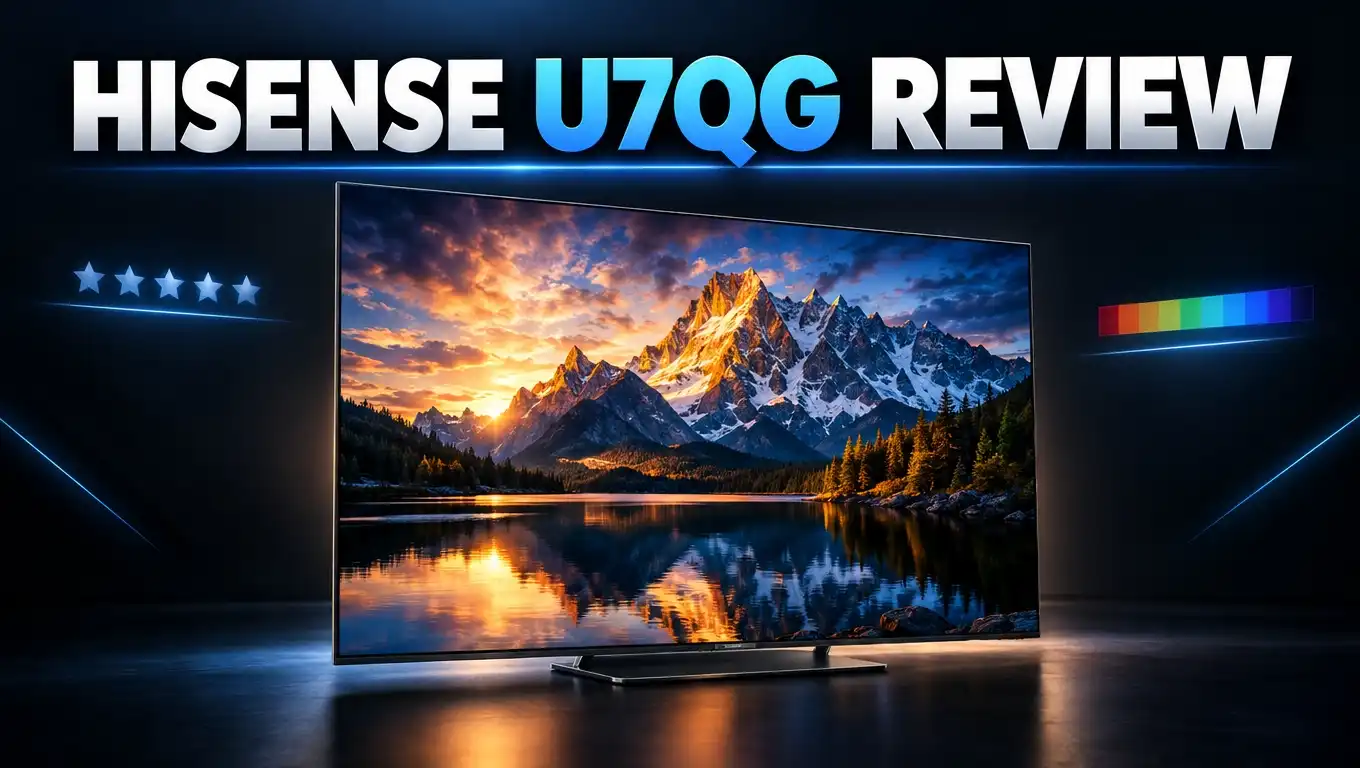
Hisense U7QG Review: A Bright Mini LED TV Worth Buying?
Do you want a TV that gets very bright, games smoothly, and still costs less than a flagship? The Hisense U7QG might be the answer. It is the 2025 midrange Mini LED TV from Hisense, sold under the model name U75QG.
I went through expert reviews, test data, and owner feedback to see how it really performs. This review covers brightness, gaming, smart features, and weak spots. By the end, you will know if this TV fits your living room and budget.
In a Nutshell
- Huge brightness for the price: Hisense rates the U7QG at up to 3,000 nits, and testers measured well over 2,000 nits. It handles bright rooms well and makes HDR movies look bold and vivid.
- A gamer’s dream setup: You get four HDMI 2.1 ports, and each one supports 4K at 165Hz and 1080p at 288Hz. Input lag is very low, and the Game Bar adds useful tools like an FPS counter.
- Strong contrast for an LED TV: The Mini LED backlight gives deep blacks with little blooming. It still cannot match OLED, but it comes close in many dark scenes.
- Full HDR support: The TV plays Dolby Vision, HDR10+, HDR10, and HLG. You do not need to worry about which format your streaming app uses.
- Some midrange weak spots: Viewing angles are mediocre, upscaling of low quality video is average, and the screen picks up some reflections. Some early owners also had a Disney+ streaming bug.
- Excellent overall value: The 65 inch model launched at $899.99, and sale prices often drop much lower. For most buyers, it delivers near premium performance for a midrange price.
Hisense U7QG Overview: What This TV Offers

- Mini-LED Pro With Up to 3000 Local Dimming Zones And Up to 3000 nits Peak Brightness: See the realism of every shadow cast by the...
- Native 165Hz Panel With Game Booster 288: Turbo power your gaming! The Native 165Hz Panel has a Variable Refresh Rate of 48Hz to 165Hz...
Last update on 2026-10-17 / Affiliate links / Images from Amazon Product Advertising API
The Hisense U7QG replaces the popular U7N from 2024. Hisense kept the same goal for this model: offer premium features without the premium price. This year, the company pushed brightness and contrast even higher.
The TV uses a Mini LED backlight with quantum dot color. Thousands of tiny LEDs sit behind the screen in dimming zones. These zones turn up or down to match the picture, so bright and dark areas look more accurate.
It comes in several sizes, from 55 inches up to 100 inches. The 65 inch version is the most popular choice. It launched at $899.99, and the 55 inch model often sells for under $700 on sale.
Reviewers liked this TV a lot. WIRED gave it an 8 out of 10 and called it one of the best value TVs of the year. ZTGD called it “the new midrange king” and praised its gaming speed.
Here is a quick look at the key specs. The TV has a native 165Hz refresh rate and VRR up to 288Hz. It runs Google TV and supports Apple AirPlay and Google Cast. It also includes an ATSC 3.0 tuner for NextGen over the air broadcasts.
Think of the U7QG as a sports car with a family sedan price tag. It is not perfect in every lap, but it is fast where it counts. In the next sections, we will look at each part in detail.
Design and Build Quality
The U7QG has a clean and simple look. The bezels are thin, but you can still see them. The shell is made of plastic, which keeps the weight low.
The 65 inch model weighs only about 49 pounds with the stand. That is light for a TV this bright. Two people can lift and place it without much effort.
The stand uses a center pedestal style design. You attach two feet and slide a plastic cover over them. It looks classy, and the legs include cable management to hide wires.
The stand depth is about 12 inches. This leaves little room for a soundbar in front of the screen on a narrow table. One reviewer found a soundbar fit underneath at the highest position, but it slightly covered the bottom edge.
The TV is just under three inches thick. That is normal for a Mini LED TV. It will not hug the wall like an OLED, but it still looks neat when mounted.
The HDMI ports sit on the left side in a recessed area. This can make access tricky if you mount the TV on a wall. Plug in your devices before you hang it to save yourself a headache.
The stand is not the sturdiest base in the market. It wobbles a bit if you bump it. For homes with kids or pets, wall mounting is a safer choice.
Overall, the design feels modern and practical. It does not scream luxury, but it does not look cheap either. For the price, the build quality is fair and functional.
Setup and First Impressions
Setting up the U7QG is quick and easy. You attach the feet in a few minutes. Then you power it on and follow the Google TV setup on screen.
The Google TV app on your phone speeds things up. You can pick your apps and sign in to accounts fast. Google can even fill in some app passwords for you, which saves time.
The hardest part is reading the terms and privacy screens. Both Google and Hisense ask for data permissions. Take a minute to turn off any sharing you do not want.
For picture settings, experts suggest Filmmaker mode for both HDR and SDR content. It shows movies the way directors intended. For SDR, you can lower the contrast a few points for a softer look.
If you want more punch, Theater Night mode is a solid pick. Be aware that it adds heavy motion smoothing. Some people dislike this “soap opera effect” on films.
For Dolby Vision content, Dolby Vision Dark gives the most accurate look. If it seems too dim, switch to Dolby Vision IQ. This mode reacts to room light but can make the image brighter than needed.
The TV has a light sensor that adjusts brightness automatically. Many users prefer to turn it off for consistent results. If you do, lower the Peak Brightness setting for SDR in dark rooms.
First impressions are very positive. The picture looks bright and colorful straight out of the box. With a few tweaks, it looks even better.
Top 3 Alternative for Hisense U7QG
The U7QG is a great TV, but it is not the only option. Here are three strong alternatives at different price points. Each one has its own strengths.
TCL QM7K

- QD-Mini LED: TCL's QD-Mini LED combines the merits of QLED and OLED technologies, transforming the traditional backlight into lighting...
- TCL Halo Control System: An advanced Technology Suite that includes the New Super High Energy LED Microchip, Super Condensed Micro...
Last update on 2026-10-17 / Affiliate links / Images from Amazon Product Advertising API
The TCL QM7K is the main rival to the U7QG. It is also a Mini LED TV with Google TV. It offers a 144Hz refresh rate and up to 288Hz for gaming.
It has an anti reflective screen and audio tuned by Bang and Olufsen. In side by side tests, the TCL shows warmer and more vibrant colors. The Hisense looks more natural and gets brighter.
Hisense U8QG

- MINILED PRO WITH UP TO 5000 NITS PEAK BRIGHTNESS AND UP TO 5600 LOCAL DIMMING ZONES: See the realism of every shadow cast by the...
- HI-VIEW AI ENGINE PRO: Enjoy the game from home, but feel like you’re there. Powered by the Hisense proprietary chipset, Hi-View AI...

Last update on 2026-10-17 / Affiliate links / Images from Amazon Product Advertising API
The Hisense U8QG is the step above the U7QG. It reaches up to 5,000 nits of peak brightness. It also has better handling of reflections in sunny rooms.
However, it has only three HDMI ports in total. The U7QG actually beats it on connectivity. Choose the U8QG if your room gets lots of direct sunlight.
Samsung QN90F

- OUR MOST ADVANCED 4K AI PROCESSOR: Powered by 128 neural networks to deliver AI-enhanced picture and optimized sound, resulting in an...
- TRANSFORMS EVERYTHING ON SCREEN TO IMPRESSIVE 4K RESOLUTION*: See impressive details on screen. Our AI processor upscales everything...
Last update on 2026-10-17 / Affiliate links / Images from Amazon Product Advertising API
The Samsung QN90F is a premium Mini LED TV. It offers excellent picture processing and a glare free matte screen. Its upscaling is sharper than the Hisense.
It runs Samsung’s Tizen system and supports HDR10+. It does not support Dolby Vision, though. It also costs much more than the U7QG.
Picture Quality and Brightness
Brightness is the biggest strength of the U7QG. Hisense claims up to 3,000 nits of peak brightness. Testers measured well over 2,000 nits in real use.
To put that in context, most streaming content is mastered at 1,000 nits or less. The U7QG has two or three times the brightness that most shows need. That headroom makes highlights look intense and lifelike.
In bright rooms, this TV holds up very well. One reviewer used it in a sunny living room and had very few issues. He even had to turn the brightness down in some scenes.
SDR content also looks great. Regular TV shows and older movies seem to pop like HDR. WIRED noted that a dragon fire scene in Harry Potter looked bright and fiery even in SDR.
Screen uniformity improved over last year’s model. Testers saw only slight dimming in the corners. A few faint backlight lines appeared in some content, but they were rare.
Sports fans will like this. Large green fields and bright skies look clean and even. You will not notice dirty screen effects in most games.
There is one small issue. A reviewer noticed a slight yellow tint in the picture. Changing the color temperature helped but did not remove it fully. Most viewers will not notice this unless they look closely.
Overall, the picture quality is excellent for a midrange TV. It feels close to a premium experience. The brightness alone makes it stand out in its class.
Contrast, Black Levels, and Local Dimming
Contrast is what makes a picture look deep and real. The U7QG does very well here. It delivers excellent black levels for an LED TV.
The Mini LED local dimming system controls light zones carefully. Dark areas stay dark while bright areas shine. This creates a strong sense of depth.
Blooming is a common problem with LED TVs. It shows up as a glow or halo around bright objects on dark backgrounds. The U7QG keeps blooming very low in most scenes.
Think about watching a starry night sky scene. On a cheaper TV, the stars would have fuzzy halos. On the U7QG, the stars look sharp against a deep black sky.
WIRED compared it to a Samsung QN90C from a few years ago. The new U7 was brighter with richer blacks. That shows how far midrange TVs have come.
Still, the U7QG cannot match an OLED TV. OLED pixels turn off completely for perfect black. Mini LED gets close, but it is not quite the same.
Watching in a dark room, the TV performs very well. Letterbox bars in movies stay dark and clean. Subtitles do not cause much glow either.
For most people, this contrast level is more than enough. It makes movies feel cinematic. Dark scenes in horror and sci fi films look especially good.
HDR Performance and Color
The U7QG supports all major HDR formats. This includes Dolby Vision, HDR10+, HDR10, and HLG. You get the best version of any HDR content you play.
Many TV brands skip one format. Samsung skips Dolby Vision, for example. With the Hisense, you never miss out.
HDR movies look bold and exciting. WIRED tested Mad Max: Fury Road on 4K Blu-ray. The lightning filled sandstorm scene looked “joyously bombastic” on this TV.
The quantum dot layer creates rich and vivid colors. Animated films like Encanto look bright and cheerful. Nature shows like Our Planet display lush greens and deep blues.
In Dolby Vision Dark mode, skin tones can look a little muted. Switching to Dolby Vision IQ makes colors pop more. You can choose based on your taste.
The TV handles HDR highlights very well. Sunlight, explosions, and reflections shine with real intensity. This is where the high brightness truly pays off.
One gaming reviewer felt HDR in games looked a bit dark at times. He tried different settings but could not get it perfect. Movies did not show this issue as much.
Overall, HDR performance is a highlight of this TV. It beats many TVs that cost more. Movie fans will love the dramatic punch it brings.
Gaming Performance
Gaming is where the U7QG truly shines. Hisense built this TV with gamers in mind. It offers some of the best gaming features in its class.
The TV has a native 165Hz refresh rate at 4K. It also supports up to 288Hz at 1080p. These speeds are amazing for PC gamers.
Input lag is very low. Your button presses show up on screen almost instantly. ZTGD said it had one of the fastest response times they measured on a TV of this level.
The Game Bar adds helpful tools. You can see an FPS counter, use a crosshair overlay, and check VRR status. It also supports AMD FreeSync Premium.
Here is a fun detail. The Game Bar changes its theme based on your console. It shows a different look for Xbox, PS5, and Nintendo Switch 2.
Games look stunning on this screen. WIRED played Ghost of Tsushima and loved the swirling leaves and bright vistas. Retro games also look great thanks to good upscaling.
There is one technical weakness. RTINGS found slow pixel transitions at 165Hz. This can cause some blur in very fast motion at the highest refresh rate. Most console gamers at 120Hz will not notice it.
Overall, this TV is a top pick for budget conscious gamers. It delivers premium gaming features without the premium price. Competitive and casual players will both be happy.
Smart Features and Google TV
The U7QG runs Google TV, which many reviewers love. The interface is clean and easy to use. It shows your apps and suggests content based on your habits.
You get access to thousands of apps. Netflix, YouTube, Prime Video, and Max are all here. There are also free live TV channels built into the system.
Voice search works through the remote. You can ask Google to find shows, open apps, or control smart home devices. It feels fast and natural in daily use.
The TV also supports Apple AirPlay and Google Cast. iPhone and Android users can both stream from their phones easily. You can share photos, videos, and music in seconds.
A neat feature is Google Photos as a screensaver. Your family pictures can show up when the TV is idle. It adds a personal touch to your room.
The included remote is backlit. This helps when you watch in a dark room. It also has quick access buttons and a customizable favorite button.
Some testers ran into streaming bugs. YouTube TV buffered at times over WiFi. Disney+ had motion freezes and resolution problems, even over Ethernet.
Hisense confirmed the Disney+ issue and promised a fix. If you watch Disney+ often, check for software updates after setup. An external streaming box like Apple TV can also solve this.
Connectivity and Ports
The U7QG has class leading connectivity. This is one of its best selling points. It even beats the more expensive U8QG here.
You get four HDMI 2.1 ports. Every port supports full bandwidth features. This means 4K at 165Hz, VRR, and ALLM on all four inputs.
Gamers with multiple consoles will love this. You can connect a PS5, Xbox Series X, gaming PC, and Switch 2 at once. You never need to swap cables.
One HDMI port supports eARC for soundbars. Since all ports are HDMI 2.1, you lose nothing by using it for audio. This is a big plus for home theater fans.
Other ports include two USB ports, with one being USB 3.0. There is a 3.5mm headphone jack and a digital optical output. A composite video input is present, but the adapter is sold separately.
The ATSC 3.0 tuner is a valuable extra. It works with NextGen TV broadcasts. ZTGD picked up many high quality local channels with a basic antenna.
Many premium TVs have dropped ATSC 3.0 support lately. Cord cutters who watch local sports will appreciate this feature. It gives you free over the air channels in better quality.
Wireless options include WiFi and Bluetooth. You can connect wireless headphones for private listening. Overall, the U7QG offers more connections than most TVs at any price.
Sound Quality
Hisense improved the audio system on the U7QG this year. The built in speakers sound fuller and clearer than last year’s model. Dialogue comes through well in most shows.
The TV supports Dolby Atmos. This adds a sense of height and space to supported content. It works best with movies and big action scenes.
Owners on Reddit said the speaker is “pretty good” for a TV. It handles casual viewing, news, and sitcoms without trouble. You do not need extra gear for everyday watching.
However, built in TV speakers have limits. Thin TVs do not have room for large drivers. Deep bass is limited, so explosions lack punch.
For a true home theater feel, add a soundbar. The eARC port lets you send lossless audio to a good soundbar. Bookshelf speakers are another great option.
Remember the stand depth issue. The 12 inch stand depth may not leave space for a soundbar in front. Measure your table before you buy a soundbar.
You can also mount the TV and place a soundbar below it. This setup looks clean and sounds better. It also solves the stand space problem.
Overall, the sound is above average for a TV. It is good enough for most daily use. Movie lovers should still plan for a soundbar upgrade.
Weak Spots You Should Know
No TV is perfect, and the U7QG has a few flaws. Knowing them helps you make a smart choice. Most are typical of midrange TVs.
Viewing angles are mediocre. Colors fade when you sit far to the side. This is common with LED TVs, but it matters in wide living rooms.
If your couch sits directly in front of the TV, this will not bother you. If you have seats at sharp angles, the picture will look washed out from there.
Picture processing is average. Low quality streams and old HD content can look rough around edges. Premium TVs from Sony and Samsung upscale more cleanly.
Reflections can be an issue. The screen has some glare handling, but it is not the best. In rooms with direct sunlight on the screen, you may see reflections.
Motion can look slightly jerky with Motion Enhancement turned off. This is noticeable in slow camera pans. Turning on light smoothing can help.
The Disney+ streaming bug frustrated some users. Hisense promised a fix, but it took months. Keep your TV software updated to avoid this problem.
Some owners also notice a slight yellow tint. It is subtle and not a deal breaker. Calibration can reduce it.
Despite these weak spots, the overall package is still very strong. The flaws are small compared to the value you get. For the price, these tradeoffs are fair.
Pros and Cons
Here is a quick summary of what works and what does not. This list helps you weigh your decision. Each point comes from expert testing and owner reviews.
Pros
- Incredible brightness for both HDR and SDR content, with peaks above 2,000 nits in testing.
- Excellent black levels and contrast with very little blooming around bright objects.
- Four full HDMI 2.1 ports, each supporting 4K at 165Hz and VRR for serious gamers.
- Very low input lag and a helpful Game Bar with FPS counter and console themes.
- Supports all HDR formats, including Dolby Vision and HDR10+.
- Google TV with AirPlay, Google Cast, and a handy backlit remote.
- ATSC 3.0 tuner for free NextGen over the air broadcasts.
- Strong value, with frequent sales that push the price even lower.
Cons
- Mediocre viewing angles cause colors to fade from the side.
- Average upscaling makes low quality streams look soft.
- Some screen reflections appear in rooms with direct light.
- Slow pixel transitions at 165Hz can cause minor blur in fast motion.
- Streaming app bugs, especially with Disney+, affected some users.
- Shallow stand leaves little room for a soundbar in front.
Who Should Buy the Hisense U7QG
The U7QG is a great fit for many types of buyers. Let us look at who will enjoy it most. This helps you see if it matches your needs.
Gamers are the top audience. Four HDMI 2.1 ports and 165Hz support make it ideal. Low input lag gives you a real edge in fast games.
If you own multiple consoles or a gaming PC, this TV is hard to beat. You can connect everything without swapping cables. The Game Bar adds useful tools during play.
Bright room viewers will love it too. The high brightness fights glare from windows and lamps. Daytime sports and news look clear and vivid.
Movie fans on a budget get a lot here. Dolby Vision and HDR10+ support covers every streaming service. Contrast is strong enough for a cinematic feel.
Cord cutters benefit from the ATSC 3.0 tuner. You can watch local channels free with an antenna. This saves money on cable bills.
Some buyers should look elsewhere. If you have a wide seating area, an OLED TV gives better viewing angles. If you watch lots of old DVDs or low quality streams, a Sony or Samsung may upscale better.
If your room gets heavy direct sunlight, consider the Hisense U8QG. It is brighter and handles reflections better. It costs more, but it suits very bright spaces.
For most families, the U7QG hits the sweet spot. It balances price, features, and picture quality very well.
Final Verdict
The Hisense U7QG is one of the best value TVs of 2025. It delivers brightness that rivals premium models. It packs gaming features that even flagship TVs lack.
Its Mini LED backlight creates deep blacks and bright highlights. HDR movies look dramatic and lifelike. SDR content also gets a strong boost.
Gamers get a feature list that feels almost too good for the price. Four full HDMI 2.1 ports, 165Hz refresh, and low input lag make it a gaming powerhouse.
Yes, it has some weak spots. Viewing angles are limited, and upscaling is average. A few streaming bugs need fixing through software updates.
But these flaws are small compared to the overall package. WIRED, ZTGD, and many owners agree on one thing. The U7QG delivers near premium performance at a midrange price.
If you want a bright, colorful, and gaming ready TV, this is a top choice. Watch for sales, as prices often drop well below the launch price. At a discount, it becomes an even easier pick.
Our final rating is 8.5 out of 10. It earns a strong recommendation for gamers, movie fans, and bright room viewers. For most people, the Hisense U7QG is all the TV they will need for years.
Frequently Asked Questions
Is the Hisense U7QG the same as the U75QG?
Yes, they are the same TV. U75QG is the official model number, and U7QG is the common name. Both refer to the 2025 U7 Series Mini LED TV.
How bright does the Hisense U7QG get?
Hisense rates it at up to 3,000 nits peak brightness. Expert testers measured well over 2,000 nits in real use. That is very bright for a midrange TV.
Is the Hisense U7QG good for PS5 and Xbox gaming?
Yes, it is excellent for consoles. It supports 4K at 120Hz, VRR, and ALLM on all four HDMI ports. Input lag is very low for responsive gameplay.
Does the Hisense U7QG support Dolby Vision?
Yes, it supports Dolby Vision, HDR10+, HDR10, and HLG. You get the best HDR format for any content. This includes Dolby Vision gaming on Xbox.
What is the difference between the Hisense U7QG and U8QG?
The U8QG is brighter, reaching up to 5,000 nits, and handles reflections better. The U7QG has four HDMI ports while the U8QG has only three. The U7QG also costs less.
Is the Hisense U7QG better than the TCL QM7K?
Both TVs offer great value. The Hisense gets brighter and shows more natural colors. The TCL has warmer colors and a better anti reflective screen. Your choice depends on your room and taste.
What sizes does the Hisense U7QG come in?
It comes in sizes from 55 inches up to 100 inches. The 65 inch model is the most popular. Larger sizes cost more but give a true cinema feel.
Does the Hisense U7QG need a soundbar?
The built in speakers are decent for daily use. For movies and deep bass, a soundbar is a smart upgrade. Use the eARC port for the best audio quality.

Dillip is the founder and editor of DillipWeb.com, where he simplifies the world of AI software, tech gadgets, and accessories through honest reviews, detailed comparisons, and easy-to-follow guides. With a deep passion for emerging technology, he helps everyday users make smarter, more informed tech decisions.