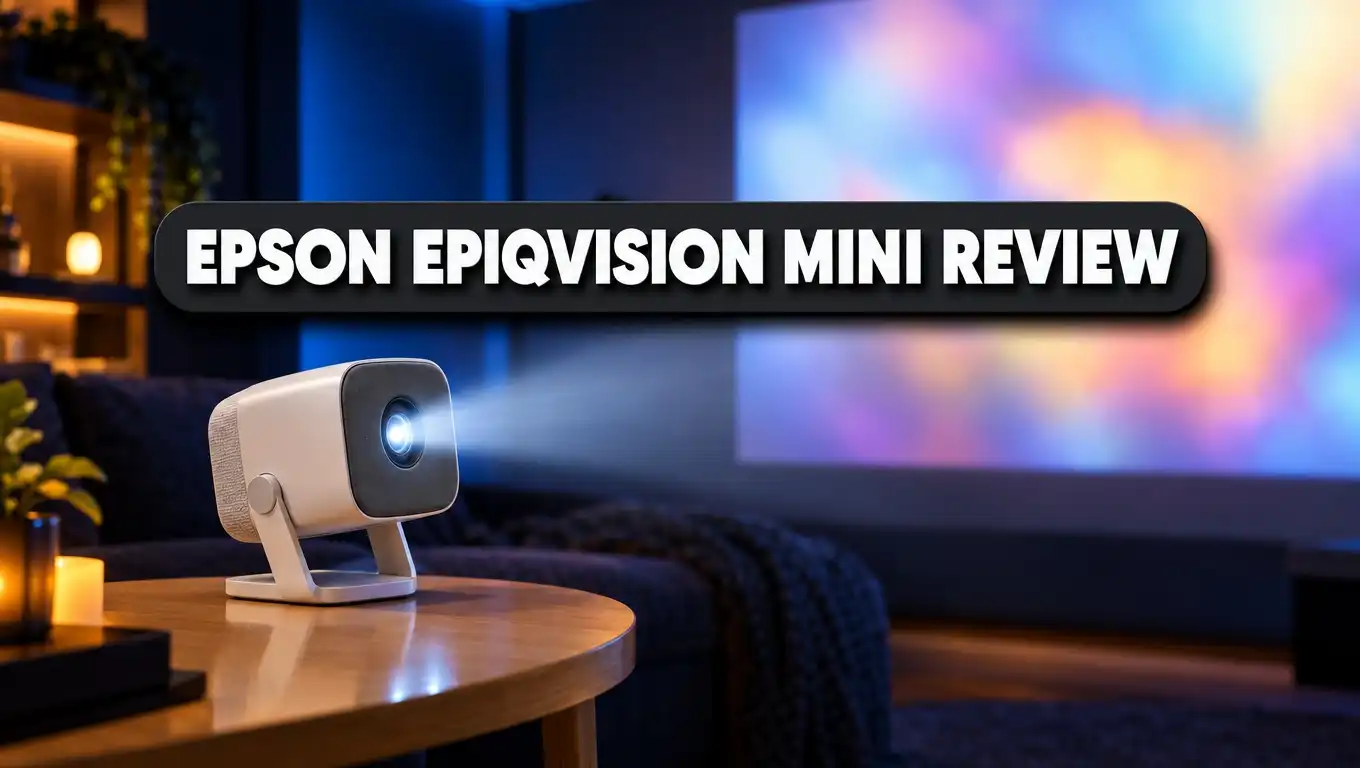
Epson EpiqVision Mini Review: Small Laser Projector Worth It?
Imagine turning a plain bedroom wall into a 150 inch movie screen in under a minute. No cables everywhere. No streaming stick. No tricky menus. That is the promise of the Epson EpiqVision Mini.
Epson builds this compact laser projector for families, renters, and anyone who loves a big screen. It is about the size of a toaster, and it still puts out a bright Full HD picture. But is it as good as Epson says?
I went through the specs, the lab tests, and real owner feedback to find out. In this review, you will learn where the EpiqVision Mini shines and where it falls short. You will also see three strong alternatives. Stick around, because the answer may surprise you.
In a Nutshell
- Bright laser picture: The EpiqVision Mini EF21 and EF22 use a 3LCD laser engine rated at 1,000 lumens. In lab tests, the EF22 measured about 1,154 lumens in Dynamic mode. That beats most portable projectors in its class.
- Accurate, natural colors: Epson’s three chip 3LCD design gives you equal color and white brightness. There is no rainbow effect. Skin tones, grass, and sky look real and pleasant.
- Google TV built in: You get over 10,000 apps, including Netflix, Disney+, Hulu, and YouTube TV. You also get Google Cast, so your phone can send video straight to the screen.
- Easy setup with EpiqSense: The projector focuses, sizes, and squares the picture on its own. The EF22 adds a 360 degree swivel stand for walls and ceilings.
- Weak spots to know: Contrast is mediocre, so black scenes look gray. Input lag is high, so serious gamers should look elsewhere. There is no battery and only one HDMI port.
- Best for: Casual movie nights, bedroom ceiling viewing, kids’ cartoons, and sports in a dim room. It is a lifestyle projector, not a home theater beast.
What Is the Epson EpiqVision Mini?
The Epson EpiqVision Mini is a family of small smart laser projectors. Epson made it for people who want a big picture without a big setup. The line started with the EF11 and the popular EF12. Today, the main models are the EF21 and EF22.
All of these projectors share one core idea. They pack a laser light source, smart streaming, and decent speakers into one small box. You plug in the power cord, connect to WiFi, and start watching.
The older EF12 used Android TV and Yamaha tuned speakers. It won many fans and awards. ProjectorCentral praised its color accuracy and its sound. However, it is now discontinued, and stock is hard to find.
The newer EF21 and EF22 switch to Google TV and Dolby Audio speakers. They also add Netflix support out of the box, which the EF12 lacked. Both models offer the same picture, the same brightness, and the same sound.
So what is the real difference? The EF22 has a built in swivel and tilt stand. The EF21 does not. That stand costs about $100 extra at full price. The EF22 launched at $999.99, and the EF21 launched at $899.99. Sale prices are often much lower.
Here is the core spec list for the current models:
Both project a native 1920 x 1080 Full HD image. Both accept HDR10 and HLG signals. The laser is rated for 20,000 hours, which is many years of nightly movies. The lens is fixed, with motor driven auto focus. You can project an image from 30 inches up to 150 inches wide.
In short, the EpiqVision Mini is a simple, stylish projector. It aims to make big screen fun easy for everyone.
Epson EpiqVision Mini EF22

- BIG SCREEN ENTERTAINMENT — Make every event truly epic by watching your favorite content on an immersive picture up to 150"
- OUTSTANDING PICTURE BRIGHTNESS — 3-chip 3LCD produces 1,000 lumens of color brightness (IDMS Rated) and 1,000 lumens of white...
Last update on 2026-10-16 / Affiliate links / Images from Amazon Product Advertising API
The EF22 is the flagship of the current EpiqVision Mini line. It is the model most people mean when they talk about this projector today. Its standout feature is the 360 degree swivel stand.
This stand lets you spin the projector left or right. It also lets you tilt it up toward the ceiling. Picture this: you lie in bed, aim the EF22 upward, and watch an 80 inch show above you. One reviewer at Projector Reviews did exactly that. He watched the news from his nightstand with a bright, colorful picture.
The EF22 weighs about 6.6 pounds. It measures roughly 7.5 inches wide, 9.3 inches tall, and 7.5 inches deep. That is light enough to carry from room to room with one hand.
Epson offers the EF22 in several colors. You can choose Stone Blue, Opal Green, Onyx Black, Quartz Rose, and more. These soft colors help it look like home decor, not tech gear.
There is one small flaw with the stand. It does not lock in place. If someone bumps it, the picture can shift. You may need to realign it after a kid or pet knocks into it.
In lab tests, the EF22 beat its brightness rating. It hit 1,154 lumens in Dynamic mode. Even in its most accurate modes, it stayed near 750 to 775 lumens. That is a strong result for a projector this small.
The EF22 also runs very quietly. Epson rates the fan at about 22 dB in normal mode and 18 dB in eco mode. Most people will not hear it during a movie.
If you want the most flexible EpiqVision Mini, the EF22 is the one to pick.
Epson EpiqVision Mini EF21

- BIG SCREEN ENTERTAINMENT — Make every event truly epic by watching your favorite content on an immersive picture up to 150"
- OUTSTANDING PICTURE BRIGHTNESS — 3-chip 3LCD produces 1,000 lumens of color brightness (IDMS-rated) and 1,000 lumens of white...
Last update on 2026-10-16 / Affiliate links / Images from Amazon Product Advertising API
The EF21 is the simpler sibling of the EF22. It has the same laser engine, the same Google TV system, and the same Dolby speakers. The only big change is the missing swivel stand.
Without the stand, the EF21 is smaller and lighter. It weighs just over 5 pounds. It has a clean, boxy shape that fits easily on a shelf or a coffee table. CNET called its size and shape “great” and compared it to a little toaster.
The EF21 has a small foot at the front. You can raise this foot to angle the picture upward. It works fine for most walls, though it is less flexible than the EF22 stand.
CNET tested the EF21 carefully. It measured about 502 lumens in the most accurate settings and about 1,044 lumens in Dynamic mode. The reviewer noted that Dynamic mode did not look as bad as these bright modes often do. So you can use it in a room with some light and still enjoy the picture.
Color is a real strength here. In side by side tests against the Anker Nebula Mars 3 Air, the EF21 showed more natural, accurate colors. Grass, sky, and faces looked more real on the Epson.
The EF21 comes in colors like Diamond White, Quartz Rose, and Opal Green. These shades look friendly and modern.
So which should you buy? Pick the EF21 if your projector will mostly sit in one spot and face one wall. Pick the EF22 if you plan to aim at ceilings or move the angle often. Watch for sales, because the EF21 often drops well below its list price.
Top 3 Alternative for Epson EpiqVision Mini
The EpiqVision Mini is a great pick, but it is not perfect for everyone. Maybe you want a battery. Maybe you want something smaller for trips. Here are three strong alternatives worth a look.

- Take the Big Screen Anywhere: This portable Google TV projector lets you watch all of your favorite content and apps—including...
- Jaw-Dropping Display: Enjoy a truly cinematic experience with rich detail and high clarity thanks to the 1080P HDR display and 400 ANSI...
Last update on 2026-10-16 / Affiliate links / Images from Amazon Product Advertising API
The Anker Nebula Mars 3 Air is a top choice for outdoor fans. It has a built in battery that lasts about 2.5 hours. That is enough for one full movie in the backyard. It runs Google TV and plays native 1080p with Dolby Digital sound. It is rated at 400 ANSI lumens, so it is dimmer than the Epson. However, CNET found its contrast slightly better, which gives dark scenes a bit more depth.

- A Whole New World of Entertainment: Google TV and Google Play Store provide seamless access to 5000+ apps like Netflix, YouTube, and...
- 1080P Super-Bright Image: With Halo+, you get brilliant 1080p FHD and LED-powered hyper-focused 700 ISO lumens in a compact build...
Last update on 2026-10-16 / Affiliate links / Images from Amazon Product Advertising API
The XGIMI Halo+ is a premium portable LED projector. It offers 700 ISO lumens, Google TV, and licensed Netflix. It also has a battery with about 2.5 hours of playtime. Its DLP chip delivers a sharp, smooth image with very little motion blur. It is a good middle ground between brightness and true portability.

- Kit includes XGIMI MoGo 3 Pro Outdoor Projector with PowerBase Stand, XGIMI Carrying Case
- Designed for the XGIMI MoGo 3 Pro: The XGIMI PowerBase Stand allows you to experience high-quality entertainment in any environment.
Last update on 2026-10-16 / Affiliate links / Images from Amazon Product Advertising API
The XGIMI MoGo 3 Pro is the smallest option here. It fits in a bag and delivers a 1080p image with 450 ISO lumens. This kit includes the PowerBase stand and a carry case. It covers about 90% of the DCI P3 color range, so colors look rich. It is ideal for travel, camping, and small rooms.
Quick tip: if you mostly watch indoors at night, the Epson stays the brightest pick. If you need a battery, choose the Nebula or XGIMI.
Design and Build Quality
The EpiqVision Mini looks more like a smart speaker than a projector. That is on purpose. Epson wants it to blend into your living space. The soft fabric style colors and rounded edges feel warm and friendly.
The build feels solid. The plastic shell does not creak or flex. The lens sits at the front, next to a small camera and sensors. That camera powers the auto focus and auto keystone features.
The EF22 also has a smart eye protection sensor. It dims the laser when someone walks in front of the lens. This is a thoughtful feature for homes with curious kids.
Air comes in from the bottom vents and goes out the side vents. So you should place the projector on a hard, flat surface. Do not set it on a soft blanket, or it may overheat.
The ports sit on the back. You get:
One HDMI port with ARC, one USB A port, one headphone jack, and one service port. The USB port can read media files from a flash drive. It can also connect a keyboard or a webcam.
Is one HDMI port enough? For most people, yes. The built in Google TV handles nearly all streaming. You will only need HDMI for a game console, laptop, or Blu ray player. If you need more, a small HDMI switch solves the problem cheaply.
The remote is simple and comfortable. It has dedicated Netflix and YouTube buttons, plus volume and brightness keys. It also has a microphone for Google Assistant voice search. Sadly, it is not backlit, so it can be tricky to use in a dark room.
Overall, the design is a big win. It looks good, feels sturdy, and stays out of the way.
Picture Quality and Brightness
Picture quality is where the EpiqVision Mini earns most of its praise. The secret is Epson’s 3LCD technology. This system uses three separate panels for red, green, and blue. They all work at the same time.
Most small projectors use a single DLP chip with a spinning color wheel. That design can cause a rainbow effect, where you see flashes of color at the edges of moving objects. The EpiqVision Mini has no rainbow effect at all.
3LCD also gives you equal color and white brightness. A 1,000 lumen rating on this Epson means bright colors, not just bright whites. Colors pop without looking fake.
The projector offers several picture modes. These include Dynamic, Vivid, Natural, Cinema, and Custom. Here is how they performed on the EF22 in lab tests:
Dynamic hit about 1,154 lumens. Vivid reached about 874 lumens. Cinema measured about 774 lumens, and Natural measured about 743 lumens.
For movies, Cinema mode gives the best mix of brightness and accuracy. For daytime sports or cartoons, Dynamic mode gives the most punch. It adds a slight cool tint, but it stays watchable.
How big should you go? Reviewers found that SDR content looks best on screens up to 100 inches. HDR content looks best at 90 inches or smaller. At 150 inches, the picture gets dim unless the room is very dark.
The Full HD image is sharp and clean for its size. It will not match a true 4K projector at the same price. But from a normal couch distance, most people will be very happy with the detail.
Contrast and Black Levels
Every product has a weak spot. For the EpiqVision Mini, it is contrast. Contrast is the gap between the brightest white and the darkest black on screen.
Epson lists a dynamic contrast of 5,000,000:1. That number sounds huge. However, it uses laser dimming tricks to get there. Real native contrast is much lower.
CNET measured the EF21 at about 348:1. That is below the 471:1 average CNET sees across projectors. In side by side tests, black bars on the Epson looked grayer than on the Anker Mars 3 Air. The image also looked a bit flatter in dark scenes.
What does this mean for you? Dark movies like The Batman or late Harry Potter films will look a little washed out. Night scenes will show gray instead of deep black. Space scenes in Star Wars will lose some of their drama.
Not every review was this harsh, though. Projector Reviews said the EF22 had better black levels than most DLP portable projectors they tested. They also praised its ability to show fine detail in shadows.
The good news is that bright content looks great. Sports, animation, news, sitcoms, and family films all shine on this projector. These are exactly the things most people watch on a lifestyle projector.
Here is a simple tip. Make your room as dark as you can for movie nights. Close the curtains and turn off the lamps. A darker room makes the gray blacks look much deeper. A proper projector screen helps too.
If deep blacks matter most to you, a larger home theater projector will serve you better. For casual fun, the EpiqVision Mini is still very enjoyable.
Google TV and Smart Features
The switch to Google TV is one of the best upgrades in the newer EpiqVision Mini models. The older EF12 used Android TV, which lacked official Netflix support. The EF21 and EF22 fix that problem completely.
Google TV gives you access to over 10,000 apps. You can open Netflix, Disney+, Hulu, Max, YouTube TV, Prime Video, and many more. You do not need a Roku, Fire Stick, or Apple TV.
The home screen is clean and smart. It shows personal recommendations based on what you watch. It also pulls shows from all your apps into one place. So finding something to watch takes less time.
Google Cast is built in too. You can send videos, photos, and music from your phone or laptop with one tap. This is perfect for sharing vacation photos with the family.
Voice control is another handy feature. Press the Google Assistant button on the remote and speak. You can say “play Bluey” or “open YouTube.” The projector responds quickly.
Because everything is built in, portability gets easier. You move the projector to a new room, plug it in, and it reconnects to WiFi. There are no extra boxes or cables to carry.
The projector supports both 2.4 GHz and 5 GHz WiFi. For smooth HD streaming, use the 5 GHz band if your router supports it. It also has Bluetooth, so you can pair wireless headphones or a Bluetooth speaker.
Some users report that the menus can feel a bit slow at times. This is common with built in smart platforms. It is not a deal breaker, but it is worth knowing. Overall, Google TV makes this projector feel like a modern smart TV.
Sound Quality
Many small projectors sound thin and tinny. The EpiqVision Mini does better than most. It packs two 5 watt speakers tuned with Dolby Audio.
The sound is clear and balanced. Dialogue comes through well, so you will not keep reaching for the volume during quiet scenes. Reviewers say it can fill a small to medium room without distortion.
You also get four sound modes. These are Standard, Vocal, Music, and Movie. Vocal mode is great for talk shows and news. Movie mode adds a fuller feel for action films.
There are limits, of course. The speakers are small, and the box is small. So you will not get deep, rumbling bass. Explosions will sound clean but not powerful. CNET put it simply: don’t expect Carnegie Hall.
Fans of the older EF12 may notice a difference. The EF12 used Yamaha tuned speakers, which ProjectorCentral called some of the best in any projector. The newer Dolby speakers are good, but some users feel the EF12 sounded a touch richer.
Want bigger sound? You have options. The HDMI ARC port can send audio to a soundbar. The headphone jack works with powered speakers. Bluetooth lets you pair wireless speakers or headphones.
Here is a fun bonus. The EpiqVision Mini can work as a Bluetooth speaker on its own. You can play music from your phone through it, even with the picture off.
For most casual viewers, the built in sound is good enough. You can skip the extra speaker setup and still enjoy your movie night.
Setup and EpiqSense Technology
Setting up a projector used to be a pain. You had to adjust focus by hand and fix crooked images. Epson solves this with EpiqSense technology.
EpiqSense uses the front camera and sensors to read your wall. It then does three jobs on its own. It focuses the image, resizes it, and squares it up. You just point the projector and wait a few seconds.
This works best on screens between 30 and 100 inches. Outside that range, you may need to fine tune things by hand in the menu.
Placement is simple. Here are the throw distances for a standard 16:9 image:
A 60 inch picture needs about 52 inches of distance. An 80 inch picture needs about 70 inches. A 100 inch picture needs about 88 inches, or a little over 7 feet. A 150 inch picture needs about 133 inches.
The lens is fixed, so there is no zoom. To make the picture bigger or smaller, you move the projector closer or farther away. Given its small size, this is easy.
Reviewers did note one issue. On the EF22, auto keystone and focus can feel a bit slow. It sometimes takes a moment to finish its work. It still beats doing it all by hand.
One more tip: keystone correction can slightly reduce sharpness. For the best picture, place the projector straight in front of the wall. Then let EpiqSense handle only small fixes.
For a first time projector owner, this setup process feels almost magical. You can go from box to movie in about ten minutes.
Gaming Performance
Can you game on the Epson EpiqVision Mini? Yes, but only casually. This is one area where the projector struggles.
The main issue is input lag. Input lag is the delay between pressing a button and seeing the action on screen. Lower is better. Serious gamers want under 40 milliseconds.
The older EF12 measured about 111 to 128 milliseconds of lag in ProjectorCentral’s tests. Epson said the smart TV system was the main cause. RTINGS found the newer EF21 also has extremely high input lag. They said even slow single player games feel sluggish.
The projector also lacks a dedicated Game Mode. It is limited to 1080p at 60Hz. There is no 120Hz support for smooth fast action.
So what games work well? Slow, relaxed games are fine. Think of Animal Crossing, board game apps, card games, or party trivia. Family game nights with casual titles can still be a blast on a 100 inch screen.
Fast games are a different story. First person shooters, fighting games, and racing games will feel delayed. You will notice your moves landing late. Competitive players will get frustrated quickly.
On the bright side, 3LCD gives you a smooth image without rainbow flashes. Colors in games look rich and bright. Your Nintendo Switch or PlayStation will connect easily through the HDMI port.
Bottom line: if gaming is your top priority, pick a gaming focused projector with low lag. If gaming is just a fun extra, the EpiqVision Mini will do the job.
Pros and Cons
Every projector involves trade offs. Here is a clear look at what the Epson EpiqVision Mini does well and where it falls short.
Pros
- Bright laser light: It measures over 1,000 lumens in Dynamic mode, which is very bright for its size.
- Natural, accurate colors: The 3LCD system shows lifelike skin tones and no rainbow effect.
- Google TV built in: You get Netflix, Disney+, Hulu, and over 10,000 apps with no extra device.
- Easy EpiqSense setup: Auto focus and auto keystone get you watching in minutes.
- Long laser life: The 20,000 hour light source needs no bulb changes.
- Quiet fan: Fan noise sits around 22 dB, so it stays nearly silent during movies.
- Stylish design: Soft colors and a compact shape make it fit any room.
- Flexible stand on the EF22: The swivel and tilt stand makes ceiling viewing easy.
Cons
- Mediocre contrast: Black scenes look gray, especially in dark movies.
- High input lag: It is not suitable for fast or competitive gaming.
- No battery: You always need a power outlet, even outdoors.
- Only one HDMI port: You may need a switch for multiple devices.
- No optical zoom: You must move the projector to change picture size.
- Pricey at full MSRP: Similar priced home theater projectors offer better contrast.
- Stand does not lock: The EF22 can shift if bumped.
As you can see, the pros mostly cover ease of use and daily fun. The cons mostly matter to movie purists and hardcore gamers. Think about how you will use it, and the choice becomes clear.
Who Should Buy the Epson EpiqVision Mini?
The EpiqVision Mini is not for everyone. But for the right person, it is a near perfect fit. Let us look at who will love it most.
Families with kids will enjoy it a lot. Cartoons and animated films look bright and colorful. The eye protection sensor adds peace of mind. Parents can set it up for a quick movie night in minutes.
Renters and small space dwellers are another great match. You do not need to mount anything on the wall. When you are done, you can tuck the projector on a shelf. It works as a big screen TV that disappears when not in use.
Bedroom viewers will love the EF22 in particular. Aim it at the ceiling and relax. It is a cozy way to watch a show before sleep.
Backyard movie fans can use it outdoors at night. Just bring an extension cord, since there is no battery. Its brightness beats most battery powered portables.
Now, who should skip it?
Home theater enthusiasts should look at larger projectors. CNET noted that the BenQ HT2060 costs only a bit more at full price. It delivers much better contrast and brightness, though it is far bigger.
Competitive gamers should also look elsewhere. The high input lag will hurt fast games.
Campers and travelers may prefer a battery model. The Nebula Mars 3 Air or XGIMI MoGo 3 Pro will serve them better.
Here is a simple rule. If you value ease, style, and bright colors over deep blacks, this projector is for you. If you want a cinema level picture, look at bigger options.
Final Verdict
So, is the Epson EpiqVision Mini worth your money? For most casual viewers, yes, especially on sale.
This projector does a lot of things right. It delivers a bright, colorful Full HD image from a small box. Its 3LCD laser engine beats most portable projectors on brightness and color accuracy. Google TV makes streaming simple. EpiqSense makes setup almost effortless.
The design is a quiet winner too. It looks good in a living room or bedroom. It runs nearly silent. The laser will last for many years without any bulb changes.
But it is not flawless. Contrast is the biggest weakness. Dark movies look a bit gray and flat. Gaming is limited by high input lag. And at full MSRP, the price feels steep for what you get.
That is why timing matters. The EF21 and EF22 often sell well below their list prices. At a lower price, the value becomes much stronger. CNET said the EF21 became “far more interesting” at its sale price.
Here is my quick advice:
Choose the EF22 if you want ceiling viewing and flexible angles. Choose the EF21 if you want the same picture for less money. Choose an alternative if you need a battery or truly deep blacks.
The Epson EpiqVision Mini is a friendly, easy, and fun projector. It brings the big screen to any room without the hassle. For family movie nights and relaxed weekend binges, it is a choice you will likely enjoy for years.
Frequently Asked Questions
What is the difference between the Epson EF21 and EF22?
Both models have the same picture, brightness, sound, and Google TV system. The EF22 adds a 360 degree swivel and tilt stand. The EF21 is lighter and cheaper but has no stand.
Does the Epson EpiqVision Mini have a built in battery?
No, it does not. You must plug it into a power outlet. For outdoor use, bring an extension cord or a portable power station.
Does the EpiqVision Mini support Netflix?
Yes. The EF21 and EF22 run Google TV with official Netflix support. The remote even has a dedicated Netflix button. The older EF12 did not include Netflix natively.
How bright is the Epson EpiqVision Mini?
Epson rates it at 1,000 lumens of color and white brightness. Lab tests showed the EF22 reaching about 1,154 lumens in Dynamic mode.
Is the Epson EpiqVision Mini good for gaming?
It works for casual and slow games. However, it has high input lag and no Game Mode. Fast shooters and fighting games will feel delayed.
Can I connect a soundbar to the EpiqVision Mini?
Yes. You can use the HDMI ARC port, the headphone jack, or Bluetooth. All three options work with external speakers.
How far should the projector sit from the wall?
For a 100 inch image, place it about 88 inches away. For an 80 inch image, place it about 70 inches away.
How long does the laser light source last?
The laser is rated for about 20,000 hours. That means years of daily use with no bulb replacement.
Does the EpiqVision Mini support 4K?
It accepts 4K signals but shows them at its native 1080p Full HD resolution. It is not a true 4K projector.
Is the older Epson EF12 still worth buying?
The EF12 is discontinued but still well loved. It has two HDMI ports and Yamaha tuned speakers. If you find one at a fair price, it is still a solid pick. Just note that it uses Android TV instead of Google TV.

Dillip is the founder and editor of DillipWeb.com, where he simplifies the world of AI software, tech gadgets, and accessories through honest reviews, detailed comparisons, and easy-to-follow guides. With a deep passion for emerging technology, he helps everyday users make smarter, more informed tech decisions.